

1772028563.png)
Tanzania has intensified its push for comprehensive air law reforms, with the Attorney General, Hon. Hamza Johari, calling for accelerated ratification and domestication of international aviation treaties to keep pace with the industry’s fast-changing landscape.
Opening the 2026 Air Law Treaty Workshop hosted by the Tanzania Civil Aviation Authority (TCAA) in collaboration with the International Civil Aviation Organization (ICAO) in Dar es Salaam, February 25, 2026., the Attorney General said aviation is undergoing sweeping technological transformation driven by Artificial Intelligence (AI), unmanned aircraft systems, digitalisation and rising cybersecurity risks.
He added that, while these innovations offer significant opportunities for growth and efficiency, he noted that they also introduce complex legal and ethical questions. He stressed the need for governments to rethink how aviation laws are legislated, regulated and enforced in order to maintain safety, security and legal certainty.
Hon. Johari underscored the central role of global aviation in connecting people, markets and cultures, supporting trade and tourism, and strengthening international relations. However, he cautioned that these benefits can only be sustained through a harmonised and coherent international air law framework.
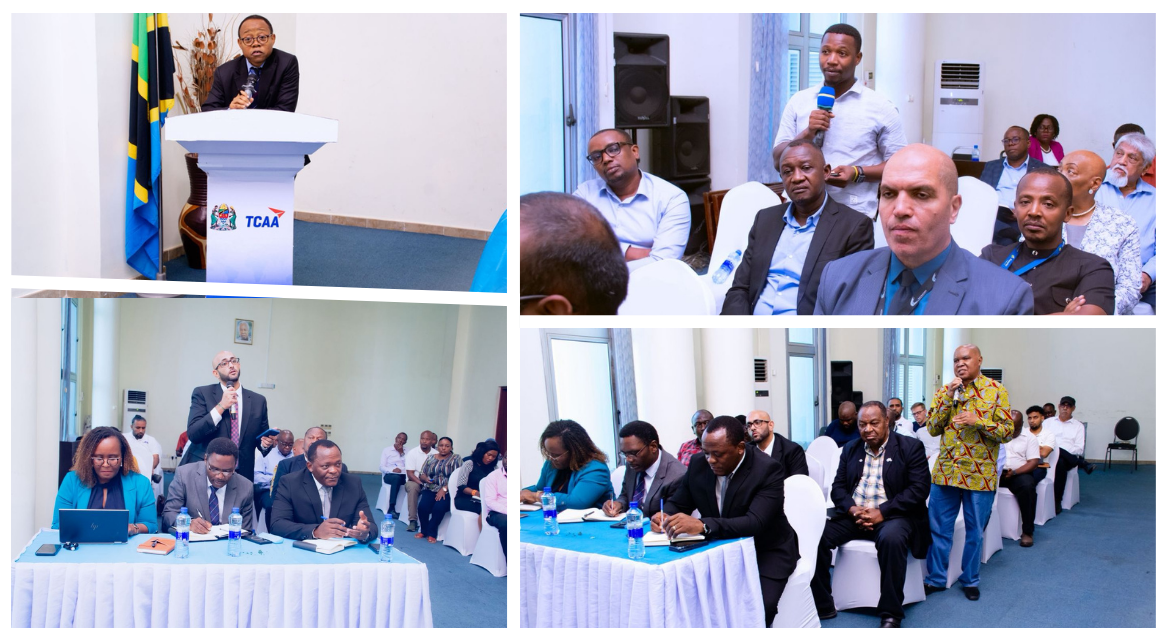
The three day workshop brought together more than 150 participants, including about 70 international delegates, to deepen understanding of air law treaties, outline the benefits and obligations of States that become parties to such instruments, and explore practical tools for ratification and effective implementation.
On his part, TCAA Director General Mr. Salim Msangi described the forum as both a learning platform and a catalyst for reform. He said the Authority is using the workshop to assess outstanding treaties that Tanzania has yet to ratify and to accelerate their domestication into national law for effective enforcement.
Mr. Msangi explained that ratifying international conventions promotes uniform application of procedures among contracting States, thereby enhancing predictability, legal certainty and confidence in cross-border aviation operations.
ICAO’s Director of Legal Affairs and External Relations Bureau, Mr. Michael Gill, reaffirmed that treaty ratification and implementation remain fundamental to achieving safe, secure, regular and sustainable air transport globally. He noted that since 1947, ICAO’s Legal Committee has developed 24 air law treaties forming the backbone of the global aviation legal system under the Chicago Convention, which recently marked its 80th anniversary.
He added that ICAO’s new Strategic Plan for 2026–2050 places renewed emphasis on strengthening States’ legal capacity and harmonising aviation laws to respond effectively to emerging global challenges.